 OpenTURNS
Note
Go to the end to download the full example code.
Use the Importance Sampling algorithm
In this example we estimate a failure probability with the importance sampling simulation algorithm provided by the ImportanceSamplingExperiment class.
The main steps of this method are:
run a FORM analysis,
create an importance distribution based on the results of the FORM results,
run a sampling-based probability estimate algorithm.
We shall consider the analytical example of a cantilever beam.
Define the cantilever beam model
from openturns.usecases import cantilever_beam
import openturns as ot
import openturns.viewer as otv
The cantilever beam example can be accessed in the usecases module :
cb = cantilever_beam.CantileverBeam()
The joint probability distribution of the input parameters is stored in the object cb :
distribution = cb.distribution
We create the model.
model = cb.model
Define the event
We create the event whose probability we want to estimate.
vect = ot.RandomVector(distribution)
G = ot.CompositeRandomVector(model, vect)
event = ot.ThresholdEvent(G, ot.Greater(), 0.30)
Run a FORM analysis
Define a solver
optimAlgo = ot.Cobyla()
optimAlgo.setMaximumCallsNumber(1000)
optimAlgo.setMaximumAbsoluteError(1.0e-10)
optimAlgo.setMaximumRelativeError(1.0e-10)
optimAlgo.setMaximumResidualError(1.0e-10)
optimAlgo.setMaximumConstraintError(1.0e-10)
Run FORM
optimAlgo.setStartingPoint(distribution.getMean())
algo = ot.FORM(optimAlgo, event)
algo.run()
result = algo.getResult()
Configure an importance sampling algorithm
The getStandardSpaceDesignPoint method returns the design point in the U-space.
standardSpaceDesignPoint = result.getStandardSpaceDesignPoint()
standardSpaceDesignPoint
The key point is to define the importance distribution in the U-space. To define it, we use a multivariate standard Gaussian centered around the design point in the U-space.
dimension = distribution.getDimension()
dimension
4
myImportance = ot.Normal(dimension)
myImportance.setMu(standardSpaceDesignPoint)
myImportance
Create the design of experiment corresponding to importance sampling. This generates a WeightedExperiment with weights fitting to the importance distribution.
experiment = ot.ImportanceSamplingExperiment(myImportance)
type(experiment)
Create the standard event corresponding to the event. This pushes the original problem to the U-space, with Gaussian independent marginals.
standardEvent = ot.StandardEvent(event)
Run the importance sampling simulation
We then create the simulation algorithm.
algo = ot.ProbabilitySimulationAlgorithm(standardEvent, experiment)
algo.setMaximumCoefficientOfVariation(0.1)
algo.setMaximumOuterSampling(40000)
algo.run()
We can retrieve results of this estimate :
result = algo.getResult()
probability = result.getProbabilityEstimate()
print("Probability = ", probability)
Probability = 4.554227632606641e-07
The confidence interval of level  is:
is:
ci95 = result.getProbabilityDistribution().computeBilateralConfidenceInterval(0.95)
print("Confidence interval (0.95) = ", ci95)
Confidence interval (0.95) = [3.66496e-07, 5.4435e-07]
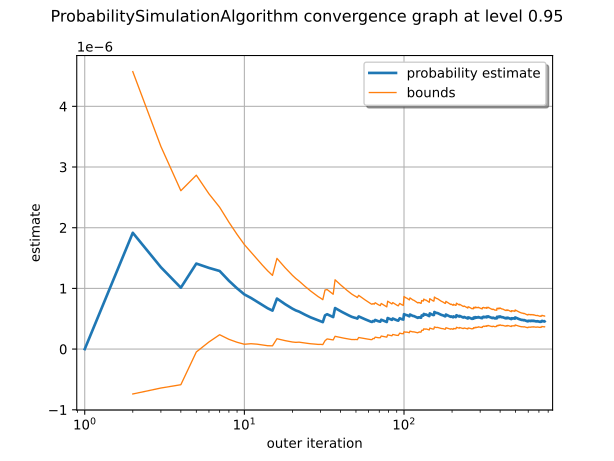
We can observe the convergence history of the estimate with the drawProbabilityConvergence method which displays the estimate and confidence interval evolution.
graph = algo.drawProbabilityConvergence()
graph.setLogScale(ot.GraphImplementation.LOGX)
view = otv.View(graph)
otv.View.ShowAll()