 OpenTURNS
Note
Go to the end to download the full example code.
Create a covariance model with and without a nugget effect
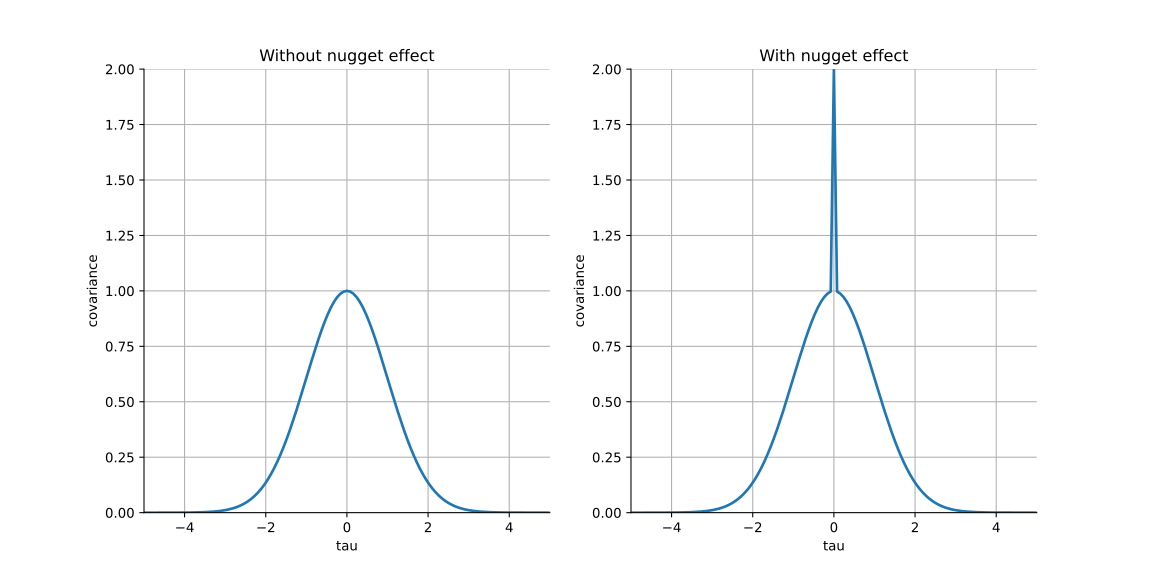
This example shows the impact of a nugget effect on the covariance function of a process:
we create two covariance functions: the second one adds a nugget effect to the first one,
we draw the covariance functions.
The nugget effect allows us to model a noise observed in the output values of a process. This noise may be, for example, a measurement noise from a sensor with finite precision.
The noise is characterized by the scalar
 which is added to the correlation function evaluated on each
  where
where
 . See Covariance models to get more details on covariance models and
the introduction of a nugget factor, and in particular see equation (5).
. See Covariance models to get more details on covariance models and
the introduction of a nugget factor, and in particular see equation (5).
import openturns as ot
import openturns.viewer as otv

# sphinx_gallery_thumbnail_number = 1
First we create the covariance function of a process defined on  and with scalar
outputs. We use the
and with scalar
outputs. We use the SquaredExponential with unit scale, unit amplitude. By default, the
nugget factor is equal to  (defined through the CovarianceModel-DefaultNuggetFactor
key in the class
(defined through the CovarianceModel-DefaultNuggetFactor
key in the class ResourceMap) which allows the regularization of the covariance
matrix. We set it to zero.
cov_model = ot.SquaredExponential()
cov_model.setNuggetFactor(0.0)
Then, we create a second covariance function which adds a nugget factor to the first one with.
We take the nugget factor  .
.
cov_model_with_nugget = ot.SquaredExponential()
epsilon_nugget = 1
cov_model_with_nugget.setNuggetFactor(epsilon_nugget)
We draw the covariance function with and without the nugget effect.
g = cov_model.draw()
g.setBoundingBox(ot.Interval([-5, 0.0], [5.0, 2.0]))
g.setTitle("Without nugget effect")
g_nugget = cov_model_with_nugget.draw()
g_nugget.setBoundingBox(ot.Interval([-5, 0.0], [5.0, 2.0]))
g_nugget.setTitle("With nugget effect")

grid = ot.GridLayout(1, 2)
grid.setGraph(0, 0, g)
grid.setGraph(0, 1, g_nugget)
view = otv.View(grid)
otv.View.ShowAll()
Display all figures.
otv.View.ShowAll()