 OpenTURNS
LeastSquaresStrategy
- class LeastSquaresStrategy(*args)
Least squares strategy for the approximation coefficients.
- Available constructors:
LeastSquaresStrategy(weightedExp)
LeastSquaresStrategy(weightedExp, approxAlgoImpFact)
LeastSquaresStrategy(approxAlgoImpFact)
LeastSquaresStrategy(measure, approxAlgoImpFact)
LeastSquaresStrategy(measure, weightedExp, approxAlgoImpFact)
LeastSquaresStrategy(inputSample, outputSample, approxAlgoImpFact)
LeastSquaresStrategy(inputSample, weights, outputSample, approxAlgoImpFact)
- Parameters:
- weightedExp
WeightedExperiment Experimental design used for the transformed input data.
By default, the class
MonteCarloExperimentis used.- approxAlgoImpFact
ApproximationAlgorithmImplementationFactory The factory that builds the desired
ApproximationAlgorithm.By default, the class
PenalizedLeastSquaresAlgorithmFactoryis used.- measure
Distribution The input distribution
 .
.By default, the limit measure defined within the class
WeightedExperimentis used.- inputSample2-d sequence of float
The input sample of size
 .
.- outputSample2-d sequence of float
The output sample of size
.- weightssequence of float
Numerical point that are the weights associated to the input sample points such that the corresponding weighted experiment is a good approximation of
.By default, all weights are equal to
 .
.
- weightedExp
Methods
Accessor to the object's name.
Accessor to the coefficients.
Accessor to the design proxy.
Accessor to the experiments.
Accessor to the input sample.
Accessor to the measure.
getName()Accessor to the object's name.
Accessor to the output sample.
Accessor to the relative error.
Accessor to the residual.
Accessor to the weights.
hasName()Test if the object is named.
Get the model selection flag.
Get the least squares flag.
setExperiment(weightedExperiment)Accessor to the design of experiment.
setInputSample(inputSample)Accessor to the input sample.
setMeasure(measure)Accessor to the measure.
setName(name)Accessor to the object's name.
setOutputSample(outputSample)Accessor to the output sample.
setWeights(weights)Accessor to the weights.
Notes
This class is used in the functional chaos expansion context implemented in the class
FunctionalChaosAlgorithm. It is not usable outside this context.The model is approximated by the meta model defined in Functional Chaos Expansion by equation (5) and the coefficients
 are computed by solving the least squares problem defined in Functional Chaos Expansion by equation (6).
Refer to Least squares meta models for more details on the resolution of least-squares problem.
- __init__(*args)
- getClassName()
Accessor to the object’s name.
- Returns:
- class_namestr
The object class name (object.__class__.__name__).
- getDesignProxy()
Accessor to the design proxy.
- Parameters:
- designProxy
DesignProxy The design matrix.
- designProxy
- getExperiment()
Accessor to the experiments.
- Returns:
- exp
WeightedExperiment Weighted experiment used to evaluate the coefficients.
- exp
- getMeasure()
Accessor to the measure.
- Returns:
- muDistribution
Measure
defining the inner product.
- getName()
Accessor to the object’s name.
- Returns:
- namestr
The name of the object.
- getRelativeError()
Accessor to the relative error.
- Returns:
- efloat
Relative error.
- getResidual()
Accessor to the residual.
- Returns:
- erfloat
Residual error.
- hasName()
Test if the object is named.
- Returns:
- hasNamebool
True if the name is not empty.
- involvesModelSelection()
Get the model selection flag.
A model selection method can be used to select the coefficients of the decomposition which enable to best predict the output. Model selection can lead to a sparse functional chaos expansion.
- Returns:
- involvesModelSelectionbool
True if the method involves a model selection method.
- isLeastSquares()
Get the least squares flag.
There are two methods to compute the coefficients: integration or least squares.
- Returns:
- isLeastSquaresbool
True if the coefficients are estimated from least squares.
- setExperiment(weightedExperiment)
Accessor to the design of experiment.
- Parameters:
- exp
WeightedExperiment Weighted design of experiment.
- exp
- setMeasure(measure)
Accessor to the measure.
- Parameters:
- mDistribution
Measure
defining the scalar product.
- setName(name)
Accessor to the object’s name.
- Parameters:
- namestr
The name of the object.
 .
.Examples using the class

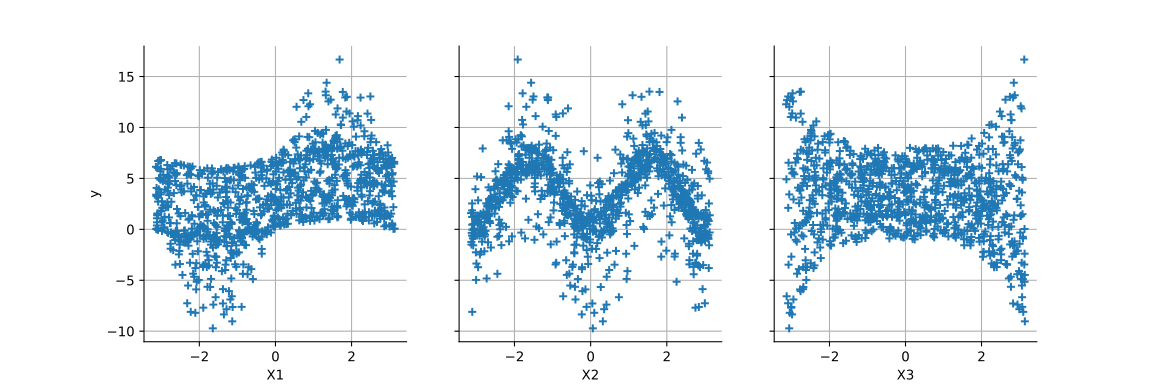
Compute leave-one-out error of a polynomial chaos expansion








Create a full or sparse polynomial chaos expansion