 OpenTURNS
P1LagrangeInterpolation
(Source code, svg)
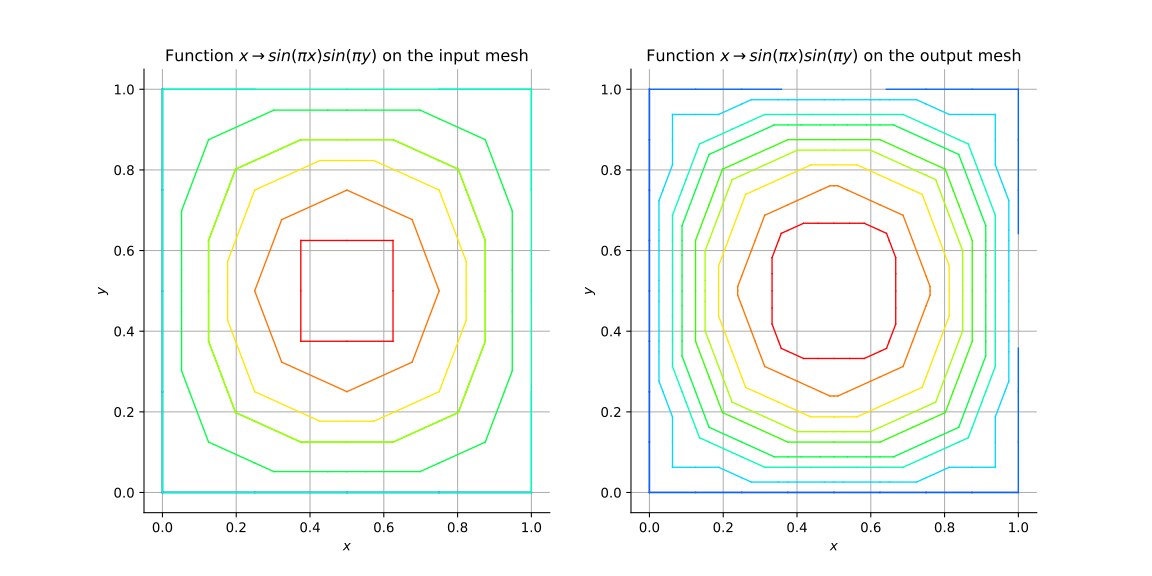
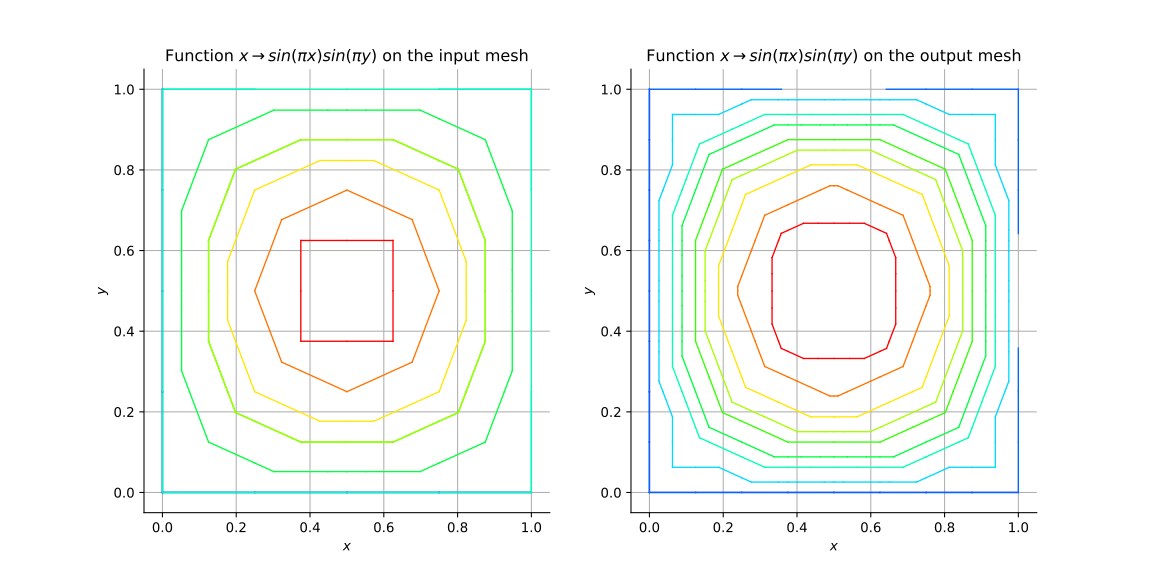
- class P1LagrangeInterpolation(*args)
P1 interpolation of values between two meshes.
Available constructors:
P1LagrangeInterpolation(inputMesh, outputMesh, dimension)
P1LagrangeInterpolation(inputMesh, outputMesh, dimension, enclosingSimplex, nearestNeighbour)
- Parameters:
- inputMesh
Mesh Input mesh.
- outputMesh
Mesh Output mesh.
- dimensionint
Dimension of fields to evaluate.
- enclosingSimplex
EnclosingSimplexAlgorithm Algorithm used to find the enclosing simplex of each output point in input mesh. If a point is not contained in any mesh simplex, the nearest point is used.
Default algorithm is
BoundingVolumeHierarchybuilt on the vertices and simplices of the inputMesh.- nearestNeighbour
NearestNeighbourAlgorithm Algorithm used to find nearest neighbour of an output point, when it is not contained in any simplex of input mesh.
Default algorithm is
KDTreebuilt on the vertices of the inputMesh.
- inputMesh
Methods
Get the number of calls of the function.
Accessor to the object's name.
Accessor to the algorithm used to find enclosing simplex.
Get the description of the input field values.
Get the dimension of the input field values.
Get the mesh associated to the input domain.
getMarginal(*args)Get the marginal(s) at given indice(s).
getName()Accessor to the object's name.
Accessor to the algorithm used to find nearest neighbours.
Get the description of the output field values.
Get the dimension of the output field values.
Get the mesh associated to the output domain.
hasName()Test if the object is named.
Whether the function acts point-wise.
setDimension(dimension)Accessor to dimension of fields which are evaluated.
setInputDescription(inputDescription)Set the description of the input field values.
setInputMesh(inputMesh)Set the mesh associated to the input domain.
setName(name)Accessor to the object's name.
setOutputDescription(outputDescription)Set the description of the output field values.
setOutputMesh(outputMesh)Set the mesh associated to the output domain.
Notes
A P1LagrangeInterpolation is a particular
FieldFunction. It allows one to evaluate aFieldFunctiondefined on a mesh (inputMesh) on another mesh (outputMesh) by piecewise linear interpolation.The P1LagrangeInterpolation builds a projection matrix between the inputMesh and the outputMesh. Then, when evaluated on the field values attached to the inputMesh, it returns the field values attached to the outputMesh.
The dimension of the field values can change. But the dimension of both meshes must be the same.
- __init__(*args)
- getCallsNumber()
Get the number of calls of the function.
- Returns:
- callsNumberint
Counts the number of times the function has been called since its creation.
- getClassName()
Accessor to the object’s name.
- Returns:
- class_namestr
The object class name (object.__class__.__name__).
- getEnclosingSimplexAlgorithm()
Accessor to the algorithm used to find enclosing simplex.
- Returns:
- enclosingSimplex
EnclosingSimplexAlgorithm Enclosing simplex algorithm.
- enclosingSimplex
- getInputDescription()
Get the description of the input field values.
- Returns:
- inputDescription
Description Description of the input field values.
- inputDescription
- getInputDimension()
Get the dimension of the input field values.
- Returns:
- dint
Dimension
 of the input field values.
- getMarginal(*args)
Get the marginal(s) at given indice(s).
- Parameters:
- iint or list of ints,

Indice(s) of the marginal(s) to be extracted.
- iint or list of ints,
- Returns:
- fieldFunction
FieldFunction The initial function restricted to the concerned marginal(s) at the indice(s)
 .
.
- fieldFunction
- getName()
Accessor to the object’s name.
- Returns:
- namestr
The name of the object.
- getNearestNeighbourAlgorithm()
Accessor to the algorithm used to find nearest neighbours.
This algorithm is used only when point is not contained in any simplex.
- Returns:
- nearestNeighbour
NearestNeighbourAlgorithm Nearest neighbour algorithm.
- nearestNeighbour
- getOutputDescription()
Get the description of the output field values.
- Returns:
- outputDescription
Description Description of the output field values.
- outputDescription
- getOutputDimension()
Get the dimension of the output field values.
- Returns:
- d’int
Dimension
 of the output field values.
- getOutputMesh()
Get the mesh associated to the output domain.
- Returns:
- outputMesh
Mesh The output mesh
 .
.
- outputMesh
- hasName()
Test if the object is named.
- Returns:
- hasNamebool
True if the name is not empty.
- isActingPointwise()
Whether the function acts point-wise.
- Returns:
- pointWisebool
Returns true if the function evaluation at each vertex depends only on the vertex or the value at the vertex.
- setDimension(dimension)
Accessor to dimension of fields which are evaluated.
- Parameters:
- dimensionint
Dimension of input fields which are going to be evaluated.
- setInputDescription(inputDescription)
Set the description of the input field values.
- Parameters:
- inputDescriptionsequence of str
Description of the input field values.
- setInputMesh(inputMesh)
Set the mesh associated to the input domain.
- Parameters:
- inputMesh
Mesh The input mesh
.
- inputMesh
- setName(name)
Accessor to the object’s name.
- Parameters:
- namestr
The name of the object.
- setOutputDescription(outputDescription)
Set the description of the output field values.
- Parameters:
- outputDescriptionsequence of str
Describes the outputs of the output field values.