 OpenTURNS
BasisOrthonormalizationAlgorithm
- class BasisOrthonormalizationAlgorithm(*args)
Basis orthonormalization algorithm.
Warning
This class is experimental and likely to be modified in future releases. To use it, import the
openturns.experimentalsubmodule.This class computes an orthonormal basis from the first
 elements of
a source
OrthogonalBasis, with respect to a target measure . The initial functions are
basis.build(0), …,basis.build(s - 1)and the inner product is
The source basis carries an instrumental measure
 , against which its functions are
naturally orthogonal. The target measure is the measure against
which the orthonormal basis is built. The two measures must have the same
dimension and the support of the target measure must be contained in the
support of the instrumental measure, otherwise the Gram matrix is not
computable or is badly conditioned; an exception is raised otherwise. A
discrete instrumental measure is exempt from the range check, because its
range is the convex hull of its support.
The initial functions do not need to be orthonormal with respect to
: the algorithm computes an orthonormal basis of the vector space
they span.Two routes are available depending on the integration rule:
experiment-derived rules expose their nodes: the basis comes from the QR factorization of the weighted design matrix, which preserves the conditioning of the design;
opaque rules only provide integrals: the basis comes from the Cholesky factorization
 of the Gram matrix, whose condition
number is the square of the design’s, hence less robust on
ill-conditioned bases.
A weighted experiment wrapped into an
ExperimentIntegrationalgorithm must integrate against the target measure: for a continuous experiment, the experiment distribution must be the target measure and its instrumental distribution must contain the support of the target measure. These checks run when the basis is computed, not whensetIntegrationAlgorithm()is called. A different measure or a missing part of the support is rejected, because it would silently produce functions that are orthonormal for another measure. When the experiment distribution does not implement equality, the equality check is skipped and the compatibility with the target measure is the caller’s responsibility; the dimension and support checks still apply. A discrete experiment such asFixedExperimentis exempt from the equality and range checks: its distribution is the empirical measure supported by the nodes, whose range is the convex hull of the nodes, which may legitimately be smaller than the target support. A customIntegrationAlgorithmintegrates against the Lebesgue measure, the density being accounted for internally.The default integration rule is built from the target measure: an independent tensor Gauss product rule is tried first, then, when the standard space is standard normal, a Gauss-Hermite product rule transported through the inverse iso-probabilistic transformation, then a Gauss-Legendre rule on the numerical range with the density folded into the weights. This makes a wide range of measures usable without a manual integration rule. The integration algorithm is not a constructor argument: the default rule is used unless
setIntegrationAlgorithm()replaces it, so that the basis, the target measure and the rule are always set consistently.- Parameters:
- basis
OrthogonalBasis Source orthogonal basis whose first elements are orthonormalized. Its measure is the instrumental measure.
- targetMeasure
Distribution Target measure against which the orthonormal basis is built.
- sizeint
Number of first elements of the source basis to orthonormalize. It must be positive.
- basis
Methods
Accessor to the object's name.
Accessor to the coefficient matrix.
Accessor to the integration algorithm.
Accessor to the target measure.
getName()Accessor to the object's name.
Accessor to the source orthogonal basis.
Accessor to the orthonormal functions.
getSize()Accessor to the number of orthonormalized basis elements.
hasName()Test if the object is named.
run()Compute the orthonormal basis.
setIntegrationAlgorithm(integrationAlgorithm)Accessor to the integration algorithm.
setName(name)Accessor to the object's name.
Notes
The following
ResourceMapkeys are used:BasisOrthonormalizationAlgorithm-DefaultDiscretization(UnsignedInteger, default:128): requested number of 1D nodes in the Gauss product experiment.BasisOrthonormalizationAlgorithm-MaximumTensorNodes(UnsignedInteger, default:1000000): maximum number of nodes of the tensor rule used to build the default integration. The marginal order is reduced when the full tensor product would exceed this budget, and the rule is rejected when the budget cannot even hold the order-2 tensor product.BasisOrthonormalizationAlgorithm-Epsilon(Scalar, default:1.0e-11): relative threshold for zeroing coefficients and detecting linearly dependent functions.
Examples
>>> import openturns as ot
>>> import openturns.experimental as otexp
>>> dim = 2
>>> distribution = ot.JointDistribution(
...     [ot.Uniform(-1.0, 1.0)] * dim, ot.FrankCopula(4.0))
>>> legendreBasis = ot.OrthogonalProductPolynomialFactory(
...     [ot.LegendreFactory()] * dim)
>>> algo = otexp.BasisOrthonormalizationAlgorithm(
...     legendreBasis, distribution, 6)
>>> algo.run()
>>> len(algo.getOrthonormalFunctions())
6
- __init__(*args)
- getClassName()
Accessor to the object’s name.
- Returns:
- class_namestr
The object class name (object.__class__.__name__).
- getCoefficients()
Accessor to the coefficient matrix.
The orthonormal basis is computed on first access if it has not been computed yet. Column
 of the matrix contains the coefficients of
the -th orthonormal function in the first elements of the
orthogonal basis.
- Returns:
- coefficients
SquareMatrix Coefficients of the orthonormal functions in the orthogonal basis.
- coefficients
- getIntegrationAlgorithm()
Accessor to the integration algorithm.
- Returns:
- integrationAlgorithm
IntegrationAlgorithm Integration algorithm.
- integrationAlgorithm
- getMeasure()
Accessor to the target measure.
- Returns:
- measure
Distribution Target measure, with respect to which the functions are orthonormalized.
- measure
- getName()
Accessor to the object’s name.
- Returns:
- namestr
The name of the object.
- getOrthogonalBasis()
Accessor to the source orthogonal basis.
- Returns:
- basis
OrthogonalBasis Source orthogonal basis whose first elements are orthonormalized. Its measure is the instrumental measure.
- basis
- getOrthonormalFunctions()
Accessor to the orthonormal functions.
The orthonormal basis is computed on first access if it has not been computed yet.
- Returns:
- functionssequence of
Function Orthonormal functions, ordered as the basis elements.
- functionssequence of
- getSize()
Accessor to the number of orthonormalized basis elements.
- Returns:
- sizeint
Number of first elements of the orthogonal basis which are orthonormalized.
- hasName()
Test if the object is named.
- Returns:
- hasNamebool
True if the name is not empty.
- run()
Compute the orthonormal basis.
- setIntegrationAlgorithm(integrationAlgorithm)
Accessor to the integration algorithm.
A rule built from a weighted experiment (e.g.
ExperimentIntegration) exposes its nodes and is used through a QR factorization. The experiment is validated when the basis is computed, not when this accessor is called. For a continuous experiment, the experiment distribution must be the target measure, and its instrumental distribution must contain the support of the target measure; otherwise an exception is raised. If the experiment distribution does not implement equality, the equality check is skipped and the caller is responsible for its compatibility with the target measure. A discrete experiment such asFixedExperimentis exempt from the equality and range checks because its distribution is the empirical measure supported by its nodes. Any other rule provides only integrals and is used through a Cholesky factorization of the Gram matrix; it integrates against the Lebesgue measure, the density being accounted for internally.- Parameters:
- integrationAlgorithm
IntegrationAlgorithm Integration algorithm.
- integrationAlgorithm
- setName(name)
Accessor to the object’s name.
- Parameters:
- namestr
The name of the object.
Examples using the class
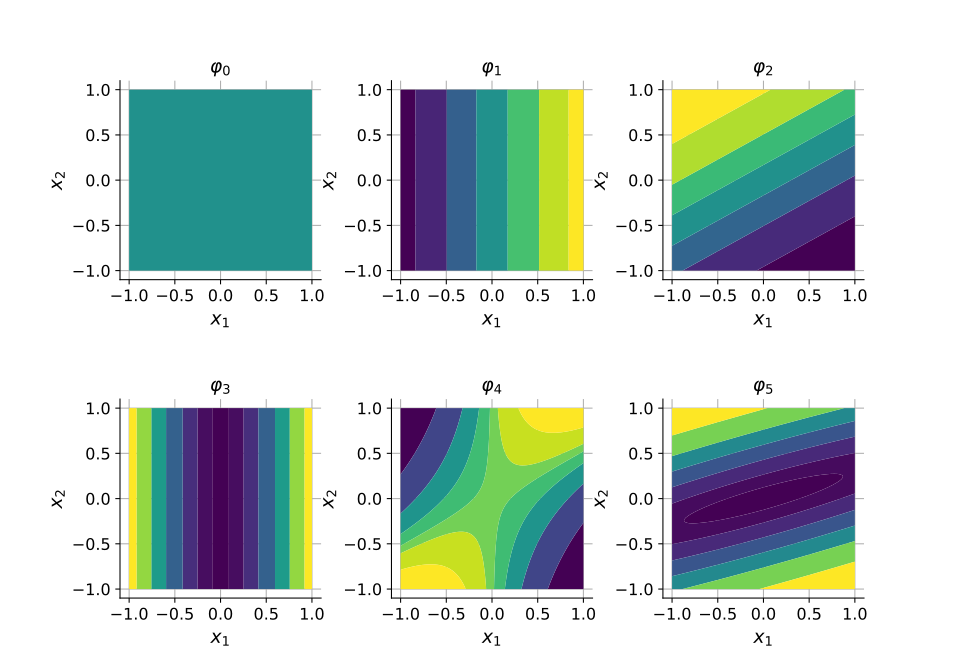
Orthonormalize a finite set of functions on a multivariate domain