 OpenTURNS
UniVariateDistributionPolynomialFactory
- class UniVariateDistributionPolynomialFactory(*args)
Build orthonormal or orthogonal univariate polynomial families.
Warning
This class is experimental and likely to be modified in future releases. To use it, import the
openturns.experimentalsubmodule.- Parameters:
- arg
DistributionorOrthonormalizationAlgorithm Either a
Distributionimplementing the probability measure according to which the polynomial family is orthonormal or anOrthonormalizationAlgorithm.In the first case, the implementation will switch to the suitable specific orthonormal univariate polynomial family if any (see the notes below), or it will default to the
AdaptiveStieltjesAlgorithmto build an orthonormal univariate polynomial family.
- arg
Methods
build(degree)Build the
 -th order orthogonal univariate polynomial.
Build the recurrence coefficients.
getA()Accessor to the scale coefficient of the affine transformation.
getB()Accessor to the translation coefficient of the affine transformation.
Accessor to the object's name.
Accessor to the specific family boolean.
Accessor to the associated probability measure.
getName()Accessor to the object's name.
Build the
-th order quadrature scheme.Accessor to the orthonormalization algorithm.
Accessor to the recurrence coefficients of the
-th order.getRoots(n)Accessor to the recurrence coefficients of the
-th order.Accessor to the specific orthonormal polynomial family.
hasName()Test if the object is named.
setName(name)Accessor to the object's name.
equals
Notes
Use this functionality with caution:
The polynomials exist if and only if the distribution admits finite moments of all orders. Otherwise, any result produced will be plain numerical noise.
Even if the polynomials exist, they form a Hilbertian basis with respect to the dot product induced by the distribution if and only if the distribution is determinate, i.e., is characterized by its moments. For example, the
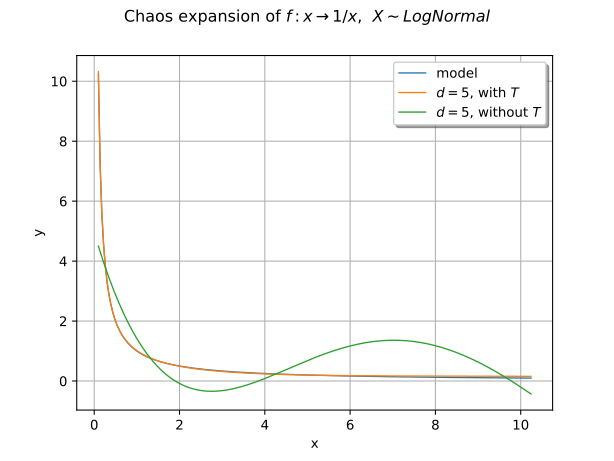
LogNormaldistribution has orthonormal polynomials of arbitrary degree but the projection onto the functional space generated by these polynomials (seeFunctionalChaosAlgorithm) may converge to a function that differs significantly from the function being projected (see [ernst2012]). See Functional Chaos Expansion for more details on this topic.
The following specific orthonormal univariate polynomial families are implemented together with their associated distributions.
Distribution
Polynomial
For a distribution which admits a standard representative in the same parametric family, the polynomial family is built for this standard representative. The affine transformation maps a random variable
 distributed according to
 to its standard representative
 . For example, if
 , its
standard representative is
 . The polynomial
 orthonormal with respect to is the composition of the
polynomial
 orthonormal with respect to the standard
representative
 and of the affine transformation:

Generic algorithms are also implemented for building orthonormal univariate polynomial families with respect to any arbitrary probability measure (implemented as a
Distribution). The library implements the followingOrthonormalizationAlgorithms, withAdaptiveStieltjesAlgorithmas the default.Examples
>>> import openturns as ot
>>> import openturns.experimental as otexp
Build the specific orthonormal polynomial factory associated to the normal distribution (Hermite):
>>> polynomial_factory = ot.UniVariateDistributionPolynomialFactory(ot.Normal())
>>> for i in range(3):
...     print(polynomial_factory.build(i))
1
X
-0.707107 + 0.707107 * X^2
Build an orthonormal polynomial factory for the WeibullMin distribution with the default orthonormalization algorithm:
>>> polynomial_factory = ot.UniVariateDistributionPolynomialFactory(ot.WeibullMin())
>>> for i in range(3):
...     print(polynomial_factory.build(i))
1
-1 + X
1 - 2 * X + 0.5 * X^2
Build an orthonormal polynomial factory for the Weibull min distribution with adaptive Stieltjes’s orthonormalization algorithm:
>>> algorithm = ot.AdaptiveStieltjesAlgorithm(ot.WeibullMin())
>>> polynomial_factory = ot.UniVariateDistributionPolynomialFactory(algorithm)
>>> for i in range(3):
...     print(polynomial_factory.build(i))
1
-1 + X
1 - 2 * X + 0.5 * X^2
Non-standard parameters trigger an affine transformation. For example, a Normal distribution with
 and
 :
>>> polynomial_factory = ot.UniVariateDistributionPolynomialFactory(ot.Normal(2.0, 3.0))
>>> polynomial_factory.getHasSpecificFamily()
True
- __init__(*args)
- build(degree)
Build the
-th order orthogonal univariate polynomial.- Parameters:
- kint,

Polynomial order.
- kint,
- Returns:
- polynomial
OrthogonalUniVariatePolynomial Requested orthogonal univariate polynomial.
- polynomial
Examples
>>> import openturns as ot
>>> polynomial_factory = ot.HermiteFactory()
>>> print(polynomial_factory.build(2))
-0.707107 + 0.707107 * X^2
- buildRecurrenceCoefficientsCollection(degree)
Build the recurrence coefficients.
Build the recurrence coefficients of the orthogonal univariate polynomial family up to the
-th order.- Parameters:
- kint,
Polynomial order.
- kint,
- Returns:
- recurrence_coefficientslist of
Point All the tecurrence coefficients up to the requested order.
- recurrence_coefficientslist of
Examples
>>> import openturns as ot
>>> polynomial_factory = ot.HermiteFactory()
>>> print(polynomial_factory.buildRecurrenceCoefficientsCollection(2))
0 : [  1         0         0        ]
1 : [  0.707107  0        -0.707107 ]
- getA()
Accessor to the scale coefficient of the affine transformation.
The affine transformation maps the variable
 to the variable
 : if is a random variable distributed according
to the associated measure, then is distributed according
to its standard representative. The polynomial is evaluated at as
the composition of the polynomial orthonormal with respect to the
standard representative and of the affine transformation,
i.e.
 .
- Returns:
- afloat
The scale coefficient
 of the affine transformation.
- getB()
Accessor to the translation coefficient of the affine transformation.
The affine transformation maps the variable
to the variable
: if is a random variable distributed according
to the associated measure, then is distributed according
to its standard representative. The polynomial is evaluated at as
the composition of the polynomial orthonormal with respect to the
standard representative and of the affine transformation,
i.e. .- Returns:
- bfloat
The translation coefficient
 of the affine transformation.
- getClassName()
Accessor to the object’s name.
- Returns:
- class_namestr
The object class name (object.__class__.__name__).
- getHasSpecificFamily()
Accessor to the specific family boolean.
- Returns:
- hasSpecificFamilybool
True if the factory has a specific orthogonal polynomial family.
- getMeasure()
Accessor to the associated probability measure.
- Returns:
- measure
Distribution The associated probability measure (according to which the polynomials are orthogonal).
- measure
Notes
Two polynomials P and Q are orthogonal with respect to the probability measure
 if and only if their dot product:

where
 and
 .
Examples
>>> import openturns as ot
>>> polynomial_factory = ot.HermiteFactory()
>>> print(polynomial_factory.getMeasure())
Normal(mu = 0, sigma = 1)
- getName()
Accessor to the object’s name.
- Returns:
- namestr
The name of the object.
- getNodesAndWeights(n)
Build the
-th order quadrature scheme.Associated with the orthogonal univariate polynomials family.
- Parameters:
- kint,

Polynomial order.
- kint,
- Returns:
Examples
>>> import openturns as ot
>>> polynomial_factory = ot.HermiteFactory()
>>> nodes, weights = polynomial_factory.getNodesAndWeights(3)
>>> print(nodes)
[-1.73205,...,1.73205]
>>> print(weights)
[0.166667,0.666667,0.166667]
- getOrthonormalizationAlgorithm()
Accessor to the orthonormalization algorithm.
- Returns:
- orthonormalizationAlgorithm
OrthonormalizationAlgorithm The univariate polynomial orthonormalization algorithm.
- orthonormalizationAlgorithm
- getRecurrenceCoefficients(n)
Accessor to the recurrence coefficients of the
-th order.Of the orthogonal univariate polynomial.
- Parameters:
- kint,
Polynomial order.
- kint,
- Returns:
- recurrence_coefficients
Point The recurrence coefficients of the
-th order orthogonal
univariate polynomial.
- recurrence_coefficients
Notes
Any sequence of orthogonal polynomials has a recurrence formula relating any three consecutive polynomials as follows:

Examples
>>> import openturns as ot
>>> polynomial_factory = ot.HermiteFactory()
>>> print(polynomial_factory.getRecurrenceCoefficients(3))
[0.5,0,-0.866025]
- getRoots(n)
Accessor to the recurrence coefficients of the
-th order.Of the orthogonal univariate polynomial.
- Parameters:
- kint,

Polynomial order.
- kint,
- Returns:
- roots
Point The roots of the
-th order orthogonal univariate polynomial.
- roots
Examples
>>> import openturns as ot
>>> polynomial_factory = ot.HermiteFactory()
>>> print(polynomial_factory.getRoots(3))
[-1.73205,...,1.73205]
- getSpecificFamily()
Accessor to the specific orthonormal polynomial family.
- Returns:
- specificFamily
OrthogonalUniVariatePolynomialFamily The specific orthonormal univariate polynomial family.
- specificFamily
- hasName()
Test if the object is named.
- Returns:
- hasNamebool
True if the name is not empty.
- setName(name)
Accessor to the object’s name.
- Parameters:
- namestr
The name of the object.