 otmeshing
Note
Go to the end to download the full example code.
Application example
This example illustrates the way we can compute the exact intersection of cylinders defining constraints
in low dimension to get the exact representation of the global admissible set.
Let’s assume that the global parameter space is of dimension  , typically
  .
Assume that this set is contained inside of a known bounding box
.
Assume that this set is contained inside of a known bounding box
![[\mathbf{a}, \mathbf{b}]](data:image/svg+xml;base64,PD94bWwgdmVyc2lvbj0nMS4wJyBlbmNvZGluZz0nVVRGLTgnPz4KPCEtLSBUaGlzIGZpbGUgd2FzIGdlbmVyYXRlZCBieSBkdmlzdmdtIDMuNiAtLT4KPHN2ZyB2ZXJzaW9uPScxLjEnIHhtbG5zPSdodHRwOi8vd3d3LnczLm9yZy8yMDAwL3N2ZycgeG1sbnM6eGxpbms9J2h0dHA6Ly93d3cudzMub3JnLzE5OTkveGxpbmsnIHdpZHRoPScyNS43NTc0NDRwdCcgaGVpZ2h0PScxMS45NTUxNjhwdCcgdmlld0JveD0nMCAtOC45NjYzNzYgMjUuNzU3NDQ0IDExLjk1NTE2OCc+CjxkZWZzPgo8cGF0aCBpZD0nZzAtOTcnIGQ9J001LjQ5OTM3Ny0zLjU3NDU5NUM1LjQ5OTM3Ny00LjY3NDQ3MSA0LjYyNjY1LTUuNDE1NjkxIDIuOTQwOTcxLTUuNDE1NjkxQzIuMjcxNDgyLTUuNDE1NjkxIC44NjA3NzItNS4zNTU5MTUgLjg2MDc3Mi00LjM1MTY4MUMuODYwNzcyLTMuODQ5NTY0IDEuMjQzMzM3LTMuNjM0MzcxIDEuNTY2MTI3LTMuNjM0MzcxQzEuOTI0NzgyLTMuNjM0MzcxIDIuMjcxNDgyLTMuODg1NDMgMi4yNzE0ODItNC4zMzk3MjZDMi4yNzE0ODItNC41NjY4NzQgMi4xODc3OTYtNC43ODIwNjcgMS45ODQ1NTgtNC45MTM1NzRDMi4zNzkwNzgtNS4wMjExNzEgMi42NjYwMDItNS4wMjExNzEgMi44OTMxNTEtNS4wMjExNzFDMy43MDYxMDItNS4wMjExNzEgNC4xOTYyNjQtNC41NjY4NzQgNC4xOTYyNjQtMy41ODY1NVYtMy4xMDgzNDRDMi4zMDczNDctMy4xMDgzNDQgLjQwNjQ3Ni0yLjU4MjMxNiAuNDA2NDc2LTEuMjU1MjkzQy40MDY0NzYtLjE2NzM3MiAxLjc5MzI3NSAuMDcxNzMxIDIuNjE4MTgyIC4wNzE3MzFDMy41Mzg3MyAuMDcxNzMxIDQuMTI0NTMzLS40MzAzODYgNC4zNjM2MzYtLjk1NjQxM0M0LjM2MzYzNi0uNTE0MDcyIDQuMzYzNjM2IDAgNS41NzExMDggMEg2LjE4MDgyMkM2LjQzMTg4IDAgNi41Mjc1MjIgMCA2LjUyNzUyMi0uMjYzMDE0QzYuNTI3NTIyLS41MTQwNzIgNi40MTk5MjUtLjUxNDA3MiA2LjI1MjU1My0uNTE0MDcyQzUuNDk5Mzc3LS41MjYwMjcgNS40OTkzNzctLjcxNzMxIDUuNDk5Mzc3LS45OTIyNzlWLTMuNTc0NTk1Wk00LjE5NjI2NC0xLjY2MTc2OEM0LjE5NjI2NC0uNTM3OTgzIDMuMTkyMDMtLjMyMjc5IDIuODA5NDY1LS4zMjI3OUMyLjIyMzY2MS0uMzIyNzkgMS43MzM0OTktLjcxNzMxIDEuNzMzNDk5LTEuMjY3MjQ4QzEuNzMzNDk5LTIuMzU1MTY4IDMuMDI0NjU4LTIuNzI1Nzc4IDQuMTk2MjY0LTIuNzg1NTU0Vi0xLjY2MTc2OFonLz4KPHBhdGggaWQ9J2cwLTk4JyBkPSdNMi40ODY2NzUtOC4yOTY4ODdMLjQxODQzMS04LjIwMTI0NVYtNy42ODcxNzNDMS4xNTk2NTEtNy42ODcxNzMgMS4yNDMzMzctNy42ODcxNzMgMS4yNDMzMzctNy4yMjA5MjJWMEgxLjc0NTQ1NUMxLjk0ODY5Mi0uMjI3MTQ4IDIuMTUxOTMtLjQ1NDI5NiAyLjM0MzIxMy0uNjkzNEMyLjk1MjkyNy0uMDU5Nzc2IDMuNjEwNDYxIC4wNzE3MzEgNC4wODg2NjcgLjA3MTczMUM1LjczODQ4MSAuMDcxNzMxIDcuMDA1NzI5LS45MzI1MDMgNy4wMDU3MjktMi42NjYwMDJDNy4wMDU3MjktNC4zMDM4NjEgNS44ODE5NDMtNS4zNzk4MjYgNC4yNDQwODUtNS4zNzk4MjZDMy41Mzg3My01LjM3OTgyNiAyLjk3NjgzNy01LjE1MjY3NyAyLjQ4NjY3NS00Ljc3MDExMlYtOC4yOTY4ODdaTTIuNTQ2NDUxLTQuMTk2MjY0QzIuOTY0ODgyLTQuNzcwMTEyIDMuNTg2NTUtNC45ODUzMDUgNC4wODg2NjctNC45ODUzMDVDNS41NzExMDgtNC45ODUzMDUgNS41NzExMDgtMy40NjY5OTkgNS41NzExMDgtMi42Nzc5NThDNS41NzExMDgtMi4xMzk5NzUgNS41NzExMDgtMS40NTg1MzEgNS4yODQxODQtMS4wMTYxODlDNC45MTM1NzQtLjQ0MjM0MSA0LjM1MTY4MS0uMzIyNzkgMy45NjkxMTYtLjMyMjc5QzMuMTU2MTY0LS4zMjI3OSAyLjcxMzgyMy0uODk2NjM4IDIuNTQ2NDUxLTEuMTU5NjUxVi00LjE5NjI2NFonLz4KPHBhdGggaWQ9J2cxLTU5JyBkPSdNMi4zMzEyNTggLjA0NzgyMUMyLjMzMTI1OC0uNjQ1NTc5IDIuMTA0MTEtMS4xNTk2NTEgMS42MTM5NDgtMS4xNTk2NTFDMS4yMzEzODItMS4xNTk2NTEgMS4wNDAxLS44NDg4MTcgMS4wNDAxLS41ODU4MDNTMS4yMTk0MjcgMCAxLjYyNTkwMyAwQzEuNzgxMzIgMCAxLjkxMjgyNy0uMDQ3ODIxIDIuMDIwNDIzLS4xNTU0MTdDMi4wNDQzMzQtLjE3OTMyOCAyLjA1NjI4OS0uMTc5MzI4IDIuMDY4MjQ0LS4xNzkzMjhDMi4wOTIxNTQtLjE3OTMyOCAyLjA5MjE1NC0uMDExOTU1IDIuMDkyMTU0IC4wNDc4MjFDMi4wOTIxNTQgLjQ0MjM0MSAyLjAyMDQyMyAxLjIxOTQyNyAxLjMyNzAyNCAxLjk5NjUxM0MxLjE5NTUxNyAyLjEzOTk3NSAxLjE5NTUxNyAyLjE2Mzg4NSAxLjE5NTUxNyAyLjE4Nzc5NkMxLjE5NTUxNyAyLjI0NzU3MiAxLjI1NTI5MyAyLjMwNzM0NyAxLjMxNTA2OCAyLjMwNzM0N0MxLjQxMDcxIDIuMzA3MzQ3IDIuMzMxMjU4IDEuNDIyNjY1IDIuMzMxMjU4IC4wNDc4MjFaJy8+CjxwYXRoIGlkPSdnMi05MScgZD0nTTIuOTg4NzkyIDIuOTg4NzkyVjIuNTQ2NDUxSDEuODI5MTQxVi04LjUyNDAzNUgyLjk4ODc5MlYtOC45NjYzNzZIMS4zODY4VjIuOTg4NzkySDIuOTg4NzkyWicvPgo8cGF0aCBpZD0nZzItOTMnIGQ9J00xLjg1MzA1MS04Ljk2NjM3NkguMjUxMDU5Vi04LjUyNDAzNUgxLjQxMDcxVjIuNTQ2NDUxSC4yNTEwNTlWMi45ODg3OTJIMS44NTMwNTFWLTguOTY2Mzc2WicvPgo8L2RlZnM+CjxnIGlkPSdwYWdlMSc+Cjx1c2UgeD0nMCcgeT0nMCcgeGxpbms6aHJlZj0nI2cyLTkxJy8+Cjx1c2UgeD0nMy4yNTE2NjEnIHk9JzAnIHhsaW5rOmhyZWY9JyNnMC05NycvPgo8dXNlIHg9JzkuNzg5NjQ0JyB5PScwJyB4bGluazpocmVmPScjZzEtNTknLz4KPHVzZSB4PScxNS4wMzM4MDMnIHk9JzAnIHhsaW5rOmhyZWY9JyNnMC05OCcvPgo8dXNlIHg9JzIyLjUwNTc4MycgeT0nMCcgeGxpbms6aHJlZj0nI2cyLTkzJy8+CjwvZz4KPC9zdmc+CjwhLS0gREVQVEg9NCAtLT4=) , and that a point
, and that a point  in
in  is admissible
if and only if it satisfies a set of constraints
is admissible
if and only if it satisfies a set of constraints  ,
where each of the
,
where each of the  acts only on a low dimensional part
 of .
The constraints are defined using one of the following options:
of .
The constraints are defined using one of the following options:
The point
must be inside of the convex hull of a set of points in arbitrary dimension;
The point
The point
The point
such that for a component
.
In all these cases, the resulting constraint define a cylinder whose base is given
by a mesh in  and whose extention is an interval in
  :
it is the cartesian product of both objects, with an injection
:
it is the cartesian product of both objects, with an injection  telling where the components
of are positioned into the components of .
telling where the components
of are positioned into the components of .
import math as m
import openturns as ot
import openturns.viewer as otv
import otmeshing as otm
from time import time
ot.RandomGenerator.Reset()
We define a set in  as the intersection of several constraints acting in
  Here is the global bounding box
a = [-4.0] * 3
b = [4.0] * 3
Algorithm used for all the intersection computation
algoInter = otm.IntersectionMesher()
Algorithm used for all the convex decomposition computation
algoDecomp = otm.ConvexDecompositionMesher()
the default is simplicial decomposition but with coacd enabled (instead of cgal) the decomposition step becomes interesting
if otm.ConvexDecompositionMesher.HasFeature("coacd"):
    algoDecomp.setUseSimplicesDecomposition(False)
    algoInter.setUseSimplicesDecomposition(False)
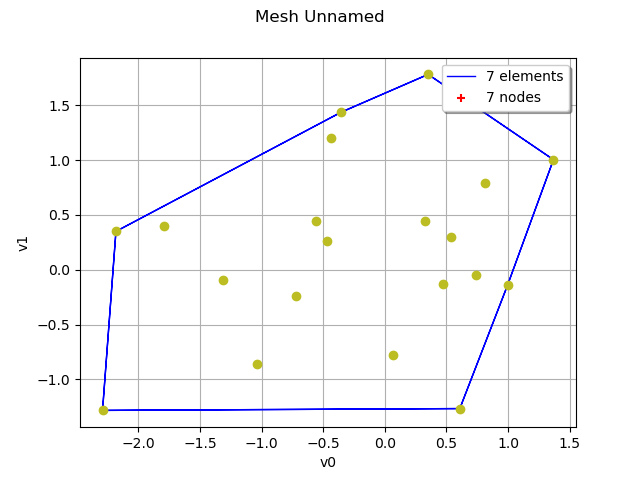
Define the first constraint  as the interior of the convex hull of a set of points in 2D
acts on
as the interior of the convex hull of a set of points in 2D
acts on 
points1 = ot.Normal(2).getSample(20)
# use ConvexHullMesher to exclude internal points
hull1 = otm.ConvexHullMesher().build(points1).getVertices()
base1 = otm.CloudMesher().build(hull1)
base1.setName(r"$C_1$")
base1.setDescription([r"$x_0$", r"$x_1$"])
extension1 = ot.Interval(a[2], b[2])
injection1 = [2]
N1 = 1
C_1 = otm.Cylinder(base1, extension1, injection1, N1)
ot.BoundaryMesher().build(C_1.computeMesh()).exportToVTKFile("C_1.vtk")
g1 = ot.BoundaryMesher().build(base1).draw()
cloud = ot.Cloud(points1)
cloud.setPointStyle("fcircle")
g11 = ot.Graph(g1)
g11.add(cloud)
g11
view = otv.View(g11)
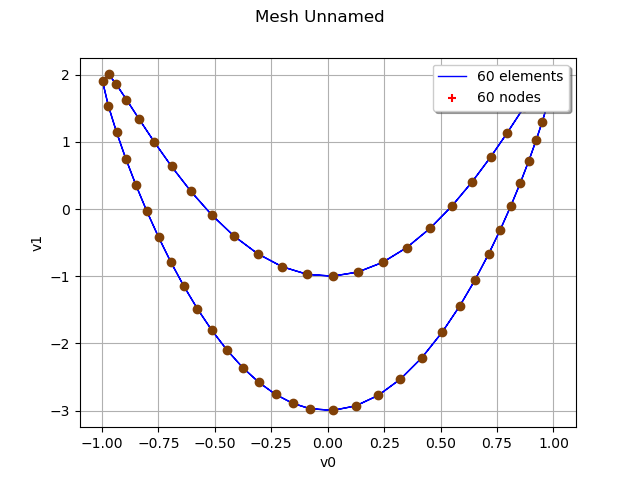
Define  as being inside of a polygon given by the vertices of its boundary
It acts on
as being inside of a polygon given by the vertices of its boundary
It acts on 
t = 0.0
dt = 1e-6
eps = 2e-1
points2 = [ot.Point([1, 2])]
# [cos(t), sin(t)+2cos(2t), t=0..2pi]
while t + dt < 2 * m.pi:
    p = ot.Point([m.cos(t + dt), m.sin(t + dt) + 2 * m.cos(2 * (t + dt))])
    dp = (p - points2[-1]).norm()
    while dp < 0.5 * eps:
        dt *= 1.1
        p = ot.Point([m.cos(t + dt), m.sin(t + dt) + 2 * m.cos(2 * (t + dt))])
        dp = (p - points2[-1]).norm()
    while dp > 2.0 * eps:
        dt /= 1.1
        p = ot.Point([m.cos(t + dt), m.sin(t + dt) + 2 * m.cos(2 * (t + dt))])
        dp = (p - points2[-1]).norm()
    points2.append(p)
    t += dt
base2 = otm.PolygonMesher().build(points2)
base2.setName(r"$C_2$")
base2.setDescription([r"$x_0$", r"$x_2$"])
extension2 = ot.Interval(a[1], b[1])
injection2 = [1]
N2 = 1
C_2 = otm.Cylinder(base2, extension2, injection2, N2)
ot.BoundaryMesher().build(C_2.computeMesh()).exportToVTKFile("C_2.vtk")
g2 = ot.BoundaryMesher().build(base2).draw()
cloud = ot.Cloud(points2)
cloud.setPointStyle("fcircle")
g22 = ot.Graph(g2)
g22.add(cloud)
g22
view = otv.View(g22)
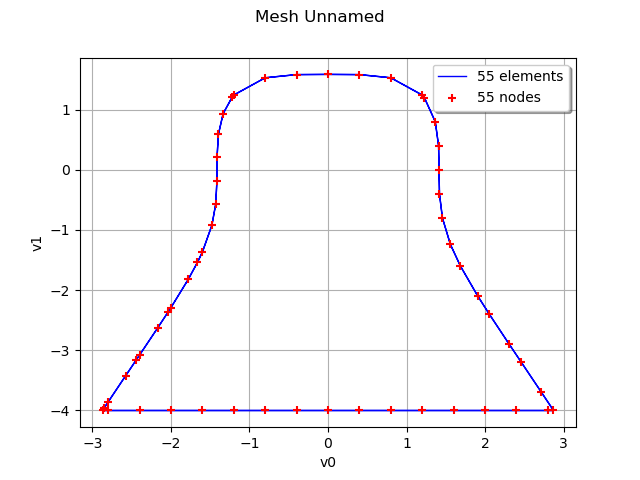
Define  as being inside of a mesh built with LevelSetMesher
It acts on
as being inside of a mesh built with LevelSetMesher
It acts on 
f3 = ot.SymbolicFunction(["x1", "x2"], ["x1^4+x2^3"])
level3 = ot.LevelSet(f3, ot.LessOrEqual(), 4.0)
n3 = 20
base3 = ot.LevelSetMesher([n3] * 2).build(level3, ot.Interval([a[1], a[2]], [b[1], b[2]]))
base3.setName(r"$C_3$")
base3.setDescription([r"$x_1$", r"$x_2$"])
extension3 = ot.Interval(a[0], b[0])
injection3 = [0]
N3 = 1
C_3 = otm.Cylinder(base3, extension3, injection3, N3)
ot.BoundaryMesher().build(C_3.computeMesh()).exportToVTKFile("C_3.vtk")
g3 = ot.BoundaryMesher().build(base3).draw()
g3
view = otv.View(g3)
Now the admissible domain
meshAllCylinders = algoInter.buildCylinder([C_1, C_2, C_3])
ot.BoundaryMesher().build(meshAllCylinders).exportToVTKFile("cylindersIntersection.vtk")
Create a uniform distribution over mesh and sample it
distribution = ot.UniformOverMesh(meshAllCylinders)
size = 1000
sample = distribution.getSample(size)
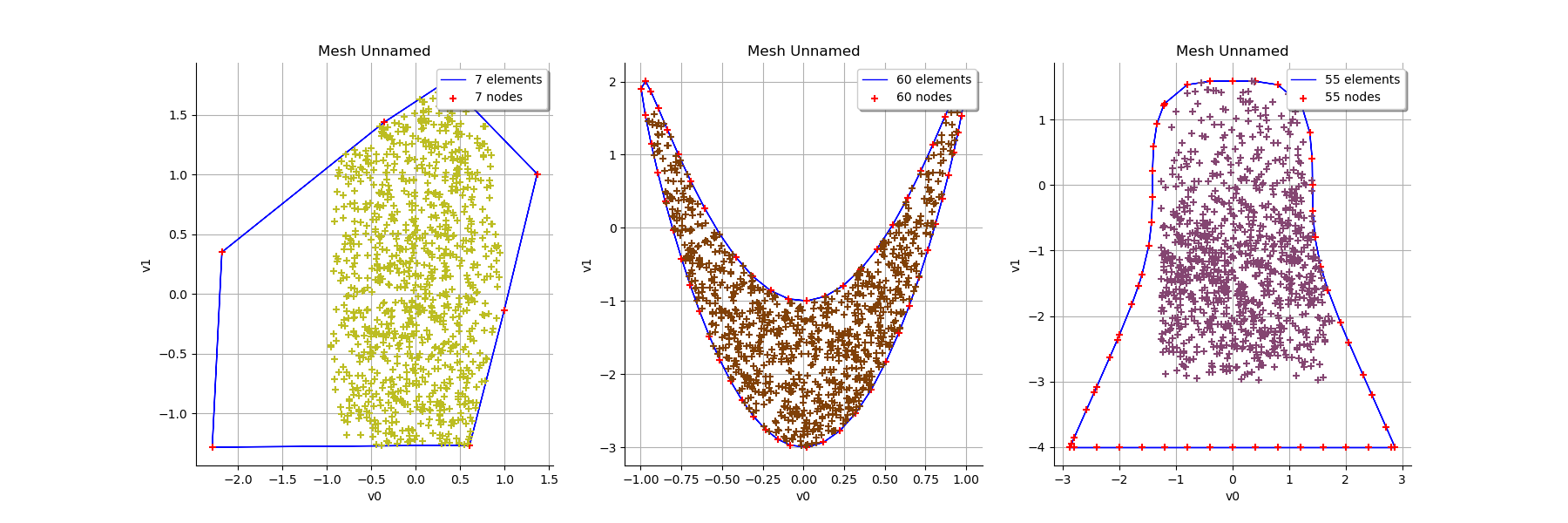
Check if all the constraints are satisfied
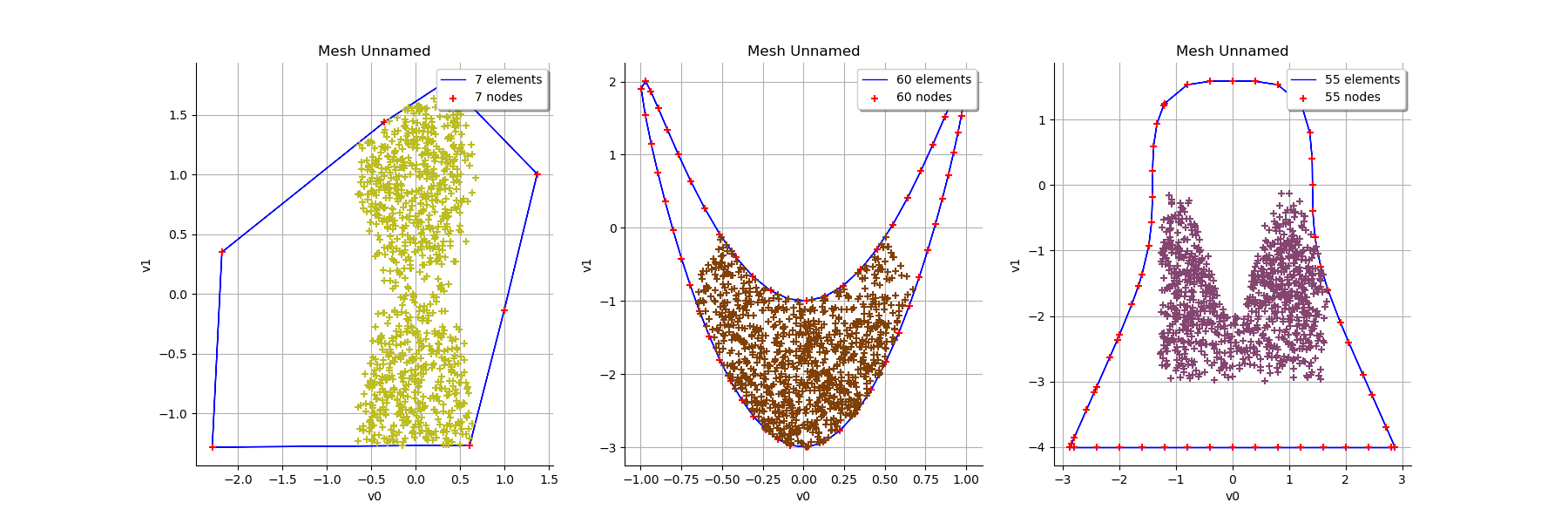
grid = ot.GridLayout(1, 3)
g1c = ot.Graph(g1)
g1c.add(ot.Cloud(sample.getMarginal([0, 1])))
grid.setGraph(0, 0, g1c)
g2c = ot.Graph(g2)
g2c.add(ot.Cloud(sample.getMarginal([0, 2])))
grid.setGraph(0, 1, g2c)
g3c = ot.Graph(g3)
g3c.add(ot.Cloud(sample.getMarginal([1, 2])))
grid.setGraph(0, 2, g3c)
grid
view = otv.View(grid)
f = ot.SymbolicFunction(["x0", "x1"], ["1+2*cos(pi_*x0/2)*sin(pi_*x1/2)^2"])
f.setName("Paraboloid")
f.setInputDescription([r"$x_0$", r"$x_1$"])
f.setOutputDescription([r"$x_2$"])
inputInterval = ot.Interval([a[0], a[1]], [b[0], b[1]])
inputDiscretization = [41] * 2
outputDimension = 2
outputDiscretization = 1
mesher = otm.FunctionGraphMesher(inputInterval, inputDiscretization)
mesh = mesher.build(f, outputDimension, a[2], b[2], 1)
ot.BoundaryMesher().build(mesh).exportToVTKFile("func_graph.vtk")

t0 = time()
meshConvexParts = algoDecomp.build(mesh)
t1 = time()
print("Number of convex parts=", len(meshConvexParts))
print(f"t={t1 - t0} s")
Number of convex parts= 78
t=28.35809302330017 s
Compute the intersection of the function graph with domain
pass directly the cylinder intersection as decomposition of convexes to avoid the final assembly step yielding incompatible topology on shared faces because of the independent triangulations of each convex component (every edge must be shared by exactly two triangles with opposite orientation) else CoACD would throw “The mesh is not a 2-manifold!”.
t0 = time()
convexPiecesAllCylinders = algoInter.buildCylinderConvex([C_1, C_2, C_3])
globalMesh = algoInter.buildWithConvexParts(mesh, convexPiecesAllCylinders)
t1 = time()
ot.BoundaryMesher().build(globalMesh).exportToVTKFile("global.vtk")
print(f"t={t1 - t0} s")
t=31.074100017547607 s
Create a uniform distribution over mesh and sample it
distribution = ot.UniformOverMesh(globalMesh)
size = 100000
sample = distribution.getSample(size)
ot.Mesh(sample).exportToVTKFile("Global_sample.vtk")
# Extract only the 1000 first points to check things in 2D
sample = sample[:1000]
# Check if all the constraints are satisfied
grid = ot.GridLayout(1, 3)
g1g = ot.Graph(g1)
g1g.add(ot.Cloud(sample.getMarginal([0, 1])))
grid.setGraph(0, 0, g1g)
g2g = ot.Graph(g2)
g2g.add(ot.Cloud(sample.getMarginal([0, 2])))
grid.setGraph(0, 1, g2g)
g3g = ot.Graph(g3)
g3g.add(ot.Cloud(sample.getMarginal([1, 2])))
grid.setGraph(0, 2, g3g)
grid
view = otv.View(grid)