 OpenTURNS
Note
Go to the end to download the full example code.
Estimate a probability using Line Sampling
In this example, we estimate the probability that the output of a function exceeds a given threshold with the Line Sampling method.
import openturns as ot
import openturns.viewer as otv
import matplotlib.pyplot as plt
Define the limit state function and the random vector
dim = 2
g_twoBranch = ot.SymbolicFunction(
    ["x1", "x2"],
    [
        "min(4 + 0.1 * (x1 - x2)^2 - (x1 + x2) / sqrt(2), 4 + 0.1 * (x1 - x2)^2 + (x1 + x2) / sqrt(2))"
    ],
)
X = ot.RandomVector(ot.Normal(dim))
Define the event
Y_twoBranch = ot.CompositeRandomVector(g_twoBranch, X)
threshold = 1.5
event_twoBranch = ot.ThresholdEvent(Y_twoBranch, ot.Less(), threshold)
Run FORM approximation
Run Line Sampling
The design point will define the initial important direction
Define the root solver
solver = ot.Brent(1e-3, 1e-3, 1e-3, 5)
rootStrategy = ot.MediumSafe(solver)
Create the algorithm
algo = ot.LineSampling(event_twoBranch, alpha_twoBranch, rootStrategy)
algo.setMaximumOuterSampling(1000)
algo.setMaximumCoefficientOfVariation(5e-2)
# disable adaptive important direction to make plots easier to interpret
algo.setAdaptiveImportantDirection(False)
Save the important direction history, and especially all root points
algo.setStoreHistory(True)
Run the simulation
algo.run()
result = algo.getResult()
print(result)
probabilityEstimate=8.191687e-03 varianceEstimate=1.672833e-07 standard deviation=4.09e-04 coefficient of variation=4.99e-02 confidenceLength(0.95)=1.60e-03 outerSampling=81 blockSize=1
Retrieve important directions
Retrieve root points and root values
rootPoints = algo.getRootPointsHistory()
rootValues = algo.getRootValuesHistory()
def drawLines(algo, n=10):
    """Draw sampling lines and the corresponding roots."""
    rootPoints = algo.getRootPointsHistory()
    alphas = algo.getAlphaHistory()
    n = min(n, len(rootPoints))
    for i in range(n):
        # there can be several roots per sample
        n_roots = len(rootPoints[i])
        alpha = alphas[i]
        for j in range(n_roots):
            if i + j == 0:
                print(f"n_roots={n_roots}")
            dp = rootPoints[i][j]
            # project design point on the hyperplane orthogonal to alpha to get origin point
            uPoint = dp
            uDot = uPoint.dot(alpha)
            uPoint = uPoint - alpha * uDot
            # draw segment origin -> design point
            plt.plot(
                (uPoint[0], dp[0]),
                (uPoint[1], dp[1]),
                color="blue",
                linestyle="--",
                linewidth=0.75,
            )
            # draw origin
            plt.plot(uPoint[0], uPoint[1], "ro", markersize=3)
            # draw design point
            plt.plot(dp[0], dp[1], "bo", markersize=3, zorder=3)
def drawLSDesign(algo):
    """Draw sampling lines, roots, and the limit state function."""
    dmin = [-4.0] * 2
    dmax = [4.0] * 2
    graph1 = g_twoBranch.draw(dmin, dmax)
    contour_g = graph1.getDrawable(0).getImplementation()
    contour_g.setColorBarPosition("")
    contour_g.setColorMap("gray")
    graph1.setDrawable(0, contour_g)
    view1 = otv.View(graph1, square_axes=True)
    # now draw the the limit state on same figure
    graph2 = g_twoBranch.draw(dmin, dmax)
    contour_g = graph2.getDrawable(0).getImplementation()
    contour_g.setLevels([threshold])
    contour_g.setColor("red")
    graph2.setDrawable(0, contour_g)
    plt.axline([-1, 1], [1, -1], linestyle="dotted", color="gray")
    drawLines(algo)
    graph2.setTitle("Line Sampling")
    _ = otv.View(graph2, figure=view1.getFigure())
Plot the limit state, a few design points and their origin
drawLSDesign(algo)
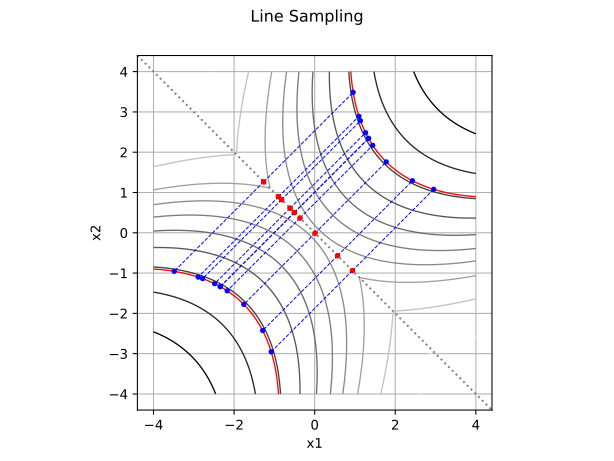
n_roots=2
Now we disable the opposite direction search to try to save function evaluations. This practice is incorrect in this case, however, as the algorithm misses half the probability of the event.
ot.RandomGenerator.SetSeed(0)
algo.setSearchOppositeDirection(False)
algo.run()
result = algo.getResult()
print(result)
probabilityEstimate=4.095844e-03 varianceEstimate=4.182082e-08 standard deviation=2.05e-04 coefficient of variation=4.99e-02 confidenceLength(0.95)=8.02e-04 outerSampling=81 blockSize=1
We plot the limit state, a few design points and their origin. This time we see each origin sample point in the orthogonal hyperplane yields only one design point.
drawLSDesign(algo)
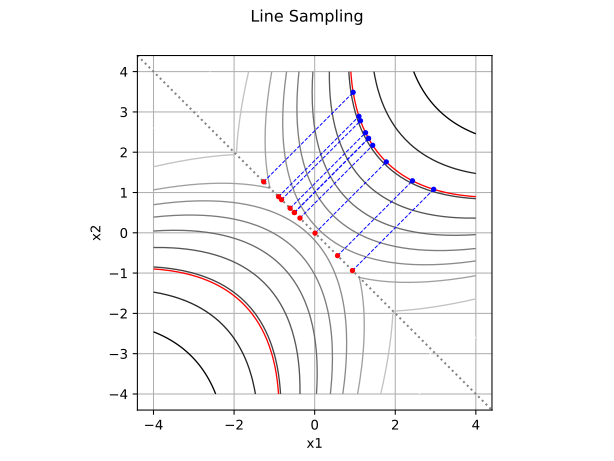
n_roots=1
Now re-enable adaptive important direction search
ot.RandomGenerator.SetSeed(0)
algo.setAdaptiveImportantDirection(True)
algo.setSearchOppositeDirection(True)
algo.run()
result = algo.getResult()
print(result)
probabilityEstimate=8.121158e-03 varianceEstimate=1.621451e-07 standard deviation=4.03e-04 coefficient of variation=4.96e-02 confidenceLength(0.95)=1.58e-03 outerSampling=79 blockSize=1
Inspect important directions (without duplicates from history)
unique_alphas = ot.Sample(0, dim)
for alpha in algo.getAlphaHistory():
    if len(unique_alphas) == 0 or alpha != unique_alphas[-1]:
        unique_alphas.add(alpha)
print("unique alphas:")
print(unique_alphas)
unique alphas:
0 : [  0.707107  0.707106 ]
1 : [ -0.343161 -0.939276 ]
2 : [ -0.631146 -0.775664 ]
3 : [  0.669986  0.742374 ]
4 : [ -0.687288 -0.726385 ]
5 : [  0.717459  0.6966   ]
6 : [ -0.716641 -0.697443 ]