 otmeshing
FunctionGraphMesher
(Source code, svg)
- class otmeshing.FunctionGraphMesher(*args)
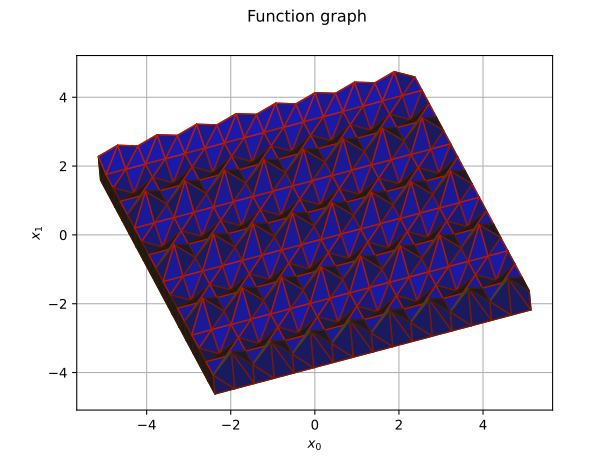
Function meshing algorithm.
Methods
build(function, outputIndex, minOutput, ...)Generate a mesh from function discretization.
Accessor to the object's name.
getName()Accessor to the object's name.
hasName()Test if the object is named.
setName(name)Accessor to the object's name.
Examples
>>> import openturns as ot
>>> import otmeshing
>>> bbox = ot.Interval([-8] * 2, [8] * 2)
>>> inputDiscretization = [10] * 2
>>> mesher = otmeshing.FunctionGraphMesher(bbox, inputDiscretization)
>>> f = ot.SymbolicFunction(['x', 'y'], ['cos(x) * sin(y)'])
>>> zIndex = 2  # z axis index
>>> zMin, zMax = 0.01, 0.3  # clip f in [0.01, 0.3]
>>> mesh = mesher.build(f, zIndex, zMin, zMax)
- __init__(*args)
- build(function, outputIndex, minOutput, maxOutput, outputDiscretization=1, subGraph=True)
Generate a mesh from function discretization.
- Parameters:
- function
openturns.Function Surface function, of output dimension 1
- outputIndexint
Index of the output variable
- minOutputfloat
Minimum output value
- maxOutputfloat
Maximum output value
- outputDiscretizationint, optional
Number of discretizations along the output axis (default=1)
- subGraphbool, optional
Whether to mesh below or above the surface (default=True: below)
- function
- Returns:
- mesh
openturns.Mesh The mesh generated.
- mesh
- getClassName()
Accessor to the object’s name.
- Returns:
- class_namestr
The object class name (object.__class__.__name__).
- getName()
Accessor to the object’s name.
- Returns:
- namestr
The name of the object.
- hasName()
Test if the object is named.
- Returns:
- hasNamebool
True if the name is not empty.
- setName(name)
Accessor to the object’s name.
- Parameters:
- namestr
The name of the object.